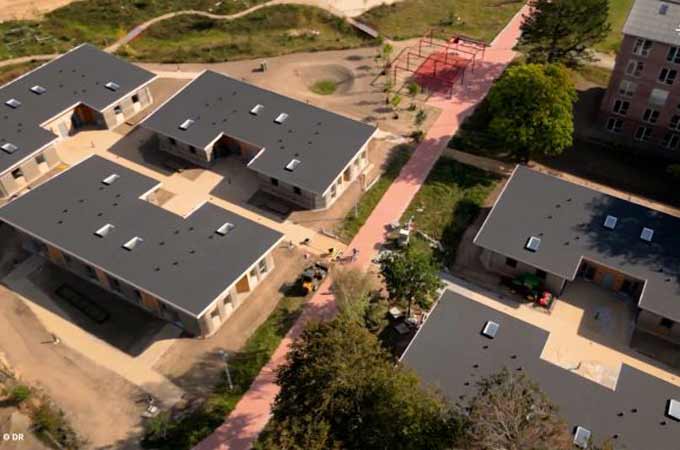
A student village of 36 3D printed apartments, Skovsporet (The Forest Trail), has been completed by 3DCP Group. Printed on site with a COBOD 3D printer for the affordable housing organisation NordVestBO, it is Europe's largest 3D printed housing project, and its first students have now moved in.
The total project size is 1,650 sq m, with apartments of 38 to 50 sq m in 6 clusters of 6 units.Printed by 3DCP Group with COBOD's construction 3D printer BOD3 for the affordable housing organisation NordVestBO; designed by SAGA Space Architects with MS+; the village sits next to VIA University College in Holstebro.The construction cost was €1,880 per sq m ($2,180)) for the buildings. The total project came in below Denmark's statutory maximum budget for subsidised housing, a limit set low enough that it constrains how much new affordable housing gets built.The entire project was printed by the same crew of just 3 people, a fraction of the workforce a conventional site of this size would need, with one building of 6 apartments (275 sq m) printed in just 5 working days.3D printed with locally sourced low-CO₂ concrete, using a cement that emits up to 30% less CO₂ in production than traditional cement. The printer worked around the site's existing trees, leaving 90% of them standing.Not enough new affordable housing is getting built in Denmark, where projects must come in under a low statutory cap on cost per square metre in a high-cost construction market with limited labour. Utilising 3D printing, Skovsporet's total project cost came in comfortably below that limit, while meeting the sector's requirements for quality and operation. Inside, every apartment works as a full home (kitchen, study space, lounge, bathroom, and a sleeping area) with generous roof windows and sloped ceilings drawing daylight deep into the rooms. Printed concrete sits alongside timber, cork paneling, and glass for a warm, Scandinavian feel. The 6 buildings frame shared courtyards, and the gardens, footpaths, and cycle parking around them are meant to balance private living with a sense of community. The buildings were designed by SAGA Space Architects together with MS+. Improvements in sustainability followed from the 3D printing. The team sourced materials locally, including a cement that emits up to 30% less CO₂ in production than traditional cement. In addition, the site was handled with the same restraint: the buildings were slotted in among the existing trees, leaving 90% of them standing.Amalie Hvas, student and new resident of one of the 3D printed apartments said about the technology:"I like it. It gives the building character. When you think of 3D printing, you picture a little machine making something in plastic - not an entire apartment!"Mikkel Brich, Co-Founder and CEO of 3DCP Group, said: "The technical breakthrough was not printing one successful structure. It was repeating the process across six clusters while improving speed, maintaining accuracy, and integrating the printed elements with conventional building systems."Philip Lund-Nielsen, Co-Founder and Chief Commercial Officer of COBOD, added: "Construction 3D printing builds affordable housing at scale, and this student village is the largest example of it in Europe so far. The students moving in benefit from lower rents, the buildings look fantastic, and we are glad to see it scaling."On the back of Skovsporet, 3DCP Group and SAGA Space Architects are already trialling new material mixes and production methods for their next projects. The development has drawn considerable international press coverage, and it makes a wider point: with the speed, precision, and repeatability of COBOD's 3D printers, printed housing meets real demand at the prices that mass market demand comes with.—TradeArabia News Service
Gulf Construction
Europe’s largest 3D printed housing project welcomes students in Denmark