
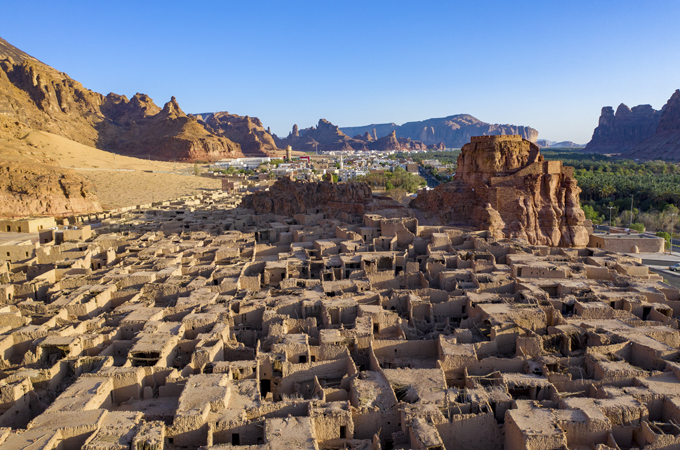
AlUla’s role as a major stop along the ancient Incense Road helped make it a crossroads for trade, ideas, craftsmanship and cultures across the Arabian Peninsula and beyond.
With evidence of human
presence dating back 200,000 years and settlement history spanning at least
7,000 years, the Saudi destination continues to reveal its deep cultural
legacy.
One of AlUla’s most
significant heritage sites is Hegra, Saudi Arabia’s first UNESCO World Heritage
Site.
More than 110
monumental tombs are found there, including 94 decorated façades that combine
Egyptian, Mesopotamian, Greek and Roman architectural influences through a
distinctive Nabataean style.
Hegra was the
principal southern city of the Nabataean Kingdom and a key point along the
Incense Road.
Nearby Dadan offers
evidence of AlUla’s artistic traditions, with monumental sandstone statues
showcasing highly developed local craftsmanship.
Influences from Egypt
and Mesopotamia are visible, while the sculptures retain a distinctive regional
character associated with the Dadanite and Lihyanite civilisations.
Camels also played a
crucial role in AlUla’s history. Their ability to transport heavy loads across
long, arid distances helped enable trade across the Arabian Peninsula.
Rock art and
archaeological discoveries highlight their importance to transport, commerce
and everyday life.
AlUla also occupied an
important position during the Roman era. In 106 CE, northern Arabia, including
Hegra, was incorporated into the Roman Empire under Emperor Trajan. Research
indicates Hegra was among the southernmost prominent cities of the empire.
In AlUla Old Town, the
Tantora sundial demonstrates how heritage was closely connected to daily life.
The traditional stone
structure tracked the winter solstice, with its shadow reaching a marker that
signalled the beginning of al-marba’ania, a 40-day winter period.
The system helped
local communities plan agricultural activities, including the cultivation of
wheat and barley.
Today, AlUla’s
heritage landscape continues to evolve through archaeological surveys,
excavations and community research.
The planned Museum of
the Incense Road, designed by architect Asif Khan, is expected to further
showcase the region’s history and its role in connecting civilisations.
Heritage forms part of AlUla’s wider tourism offering, which also encompasses nature, arts, wellness and adventure, providing visitors with new ways to explore a destination whose story continues to unfold. -TTN