
Travel planners can pre-programme meetings, networking evenings and sightseeing, but it’s impossible to strategise for serendipity. That contradiction underscores the importance of human connection at a moment when the moving finger of artificial intelligence (my apologies to the memory of Omar Khayyám) seems to be shaping every aspect of the way we do business.
So it was at November’s IBTM World, where I happened to be sitting next to Tomas Bendz, Chief Expansion Officer and Head of AI development at Invajo. The Swedish event planning software company has just launched its Invajo Intelligence Suite to customise the congress experience for participants using – naturally – AI. Now, starting with its primary operations market of scientific congresses, it wants to turn conference data, such as technical papers, abstracts and presentations into easily accessible intelligence. Up to 70% of conference abstracts never lead to a published scientific article and are rarely cited afterwards, Invajo estimates, based on a meta-review of scientific studies. The new system tackles this ‘value evaporation’ by making available research findings that would otherwise remain buried in PDFs, strengthening their long-term impact. The software has been developed together with HP and will also be available in the GCC.
The next step, Bendz said, is using AI-enabled matchmaking to connect attendees whose scientific focus areas overlap with a feature called the Personal Congress Companion. “Right now, finding other scientific partners is slow and inefficient,” he said. “So you just do the registration as normal, what you always do to these congresses, but then the system looks at the research and suggests the top 10 or 20 people to meet with at the event. It acts as your personal research assistant.”
That’s a new way the MICE sector is using AI, and I wouldn’t have stumbled across it if Benz and I weren’t attending the same panel discussion in Barcelona.
Insightful as it was, our chat wasn’t one of the staggering 79,000 pre-scheduled meetings that took place at IBTM World 2025, an eight percent increase over the previous year. That’s 12,000 people making the in-person trip to Catalonia to build meaningful connections and find business leads even as AI and digital conference technologies can facilitate any meeting at a fraction of the cost and none of the jet lag – although recreating experiences such as khaleeji henna painting or Latino dance lessons is a harder ask.
But AI was never far from the stage. Speakers cited use cases in logistics, marketing, sales and experiential design, such as automated session scheduling and audience segmentation, personalised agendas, smarter lead targeting and predictive insights, and venue design, virtual avatars and the creation of content assets. At the show itself, side screens displayed real-time English-to-Spanish translations and immediate summaries – although these were sometimes forced or incorrect, showing just how far we still need to go.
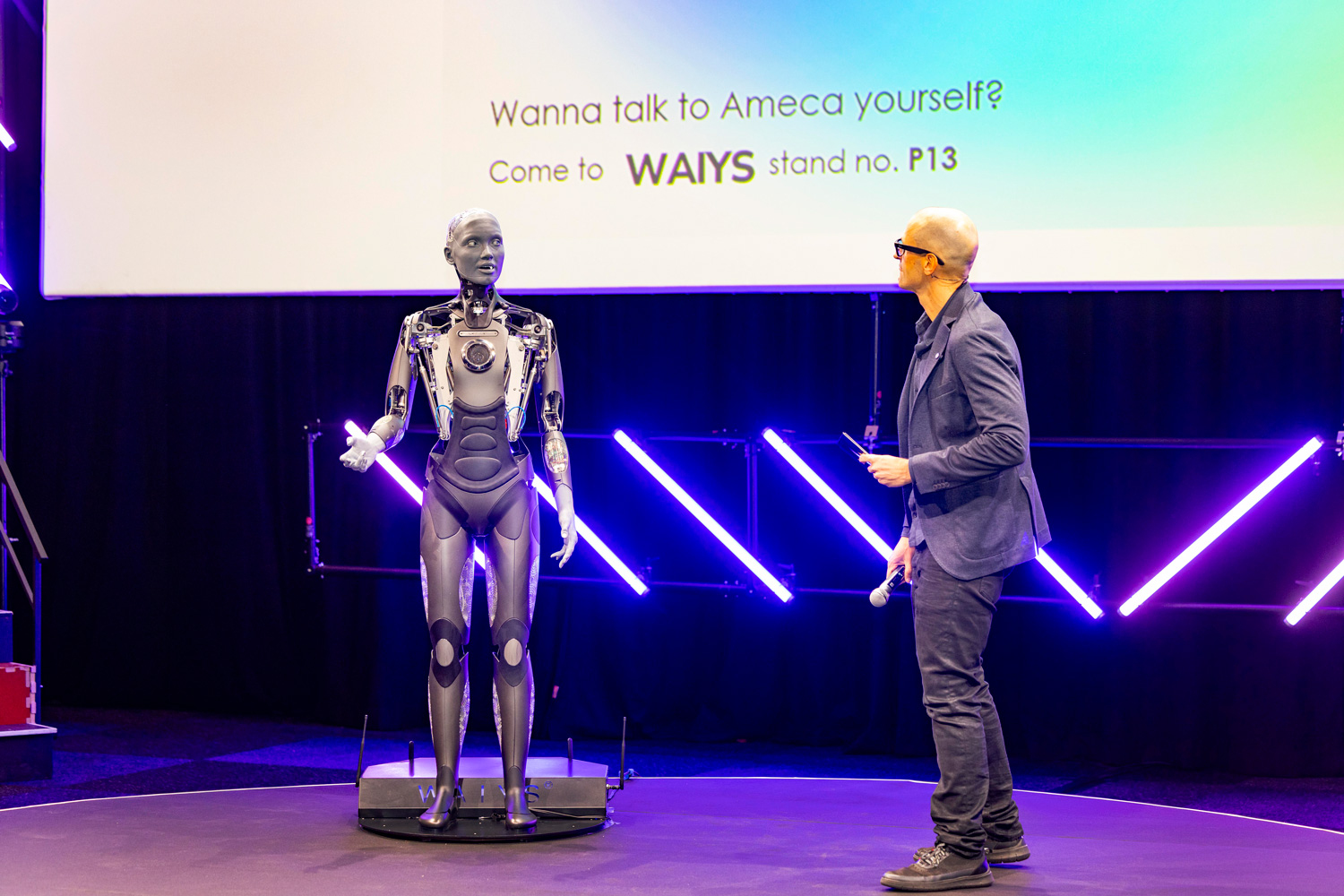
Most prominent was Ameca, a humanoid robot trained on AI inputs and designed by the UK’s Engineered Arts. At the new Future Stage, consultant Julius Solaris, founder of US event strategy company Boldpush, wanted to know whether AI is ready to take over events. The short answer: it’s a partnership.
“AI handles the heavy lifting, while humans bring vision, creativity and emotional intelligence, together,” the robot replied. “AI is the tool and human creativity is the artist.”
That message of AI-augmented performance was everywhere across the show – a reflection of just how quickly the sector has embraced different AI applications.
AI inroads into
events planning
Half of all meeting planners worldwide now actively use AI tools, according to the AMEX’s GBT 2025 Global Meetings & Events Forecast. Usage ranges from attendee matchmaking (42%) to content creation (41%), theme development (40%) and tracking engagement through data analytics (39%).
Expect the playing field to level out accordingly. A three-person agency, for instance, can now run attendee matchmaking that would have required a dedicated team two years ago, while corporate planners flying solo can produce multilingual session summaries, personalised delegate communications and post-event analytics on their own. AI tools, whether large language models or agentic applications, compress the capability gap.
But if AI is levelling up operational capability, cookie-cutter events without a truly compelling unique value proposition could begin to haemorrhage visitors. Rather than focusing on areas that are already functioning as intended, planners need to turn their attention to what makes the event worth attending in the first place.
Goc O'Callaghan, a UK-based events consultant and experience designer, called this ‘imagination poverty.’ Too many events look and feel the same, with organisers relying on overused buzzwords, she said. Conferences are casually labelled as ‘festivals’, for example, while ‘transformational’ is often just marketing garnish. “Imagination poverty is not only lazy; it is dangerous. When every experience feels familiar, the audience disengages. When sameness dominates, the industry stagnates. As the curators of events and experiences,it’s our responsibility to take accountability in our work, to use the correct terminology and to design for a desirable, not probable, future.”
Caution on AI slop
replacing creativity
Much of this can be directly traced back to the way LLMs generate their output. These tools – which sit behind ChatGPT and similar products – are responding to questions based on patterns in their training data. But when planners use these outputs without critical editorial judgement, the content – whether images, conference panel outlines or marketing strategies – tend to replicate the most generic, statistically average default.
In other words, AI slop. Instead, industry professionals must focus on getting more from their generative AI engines, for example, with detailed briefs asking for specific, achievable outcomes, by providing examples of success, and by challenging the responses returned.
“The risk is that AI is drowning out the very human creativity it was designed to enhance,” explained Alastair Turner, Managing Director of Eight PR & Marketing, in the IBTM Trends Report 2026. Drawing on data from more than 140 sources, the report looks at how events can counterbalance the digital world. AI can help personalise the event experience to every delegate by suggesting conference sessions or suggesting pathways across the floor, Turner writes, so attendees engage more fully and become long-term advocates.
That chimes with the report’s flagship focus trend. As of mid-2025, more than 1.1 billion of the world's 8 billion people are aged 60 or older. The number is set to double by 2050, reaching 16% of the population. As event attendees get older and events are designed for varying demographics, the limitations of AI’s training data may become more apparent. As Turner points out, AI personalisation engines built on data aggregated from the internet reflect underlying biases: Western, English-speaking audiences. It underrepresents older adults, people with disabilities, and non-Western communities. Therefore, responsibility, Turner says, is as important as AI – and the two words appear almost as frequently in the show’s trends report.
“AI can be really biased. It learns from historic data. We’ve got to a point where technology has evolved so much that it’s [almost] hard to reverse engineer and add things like inclusion,” said behavioural scientist Lea Karam. Her work focuses on integrating human intelligence into AI systems so the technology can serve people better as it evolves.
Put AI to work for
human needs
AI in the workplace is more of a design and culture problem than a tech problem, she said, suggesting that MICE agencies build out a comprehensive change management programme. “We have to improve the way we connect with each other and how we translate that technology within the workplace.”
But perhaps the last word belongs to behavioural scientist Nathalie Nahai, who opened the show’s conference programme with a keynote titled The Power of Human Connection & Empathy in the Age of AI. She challenged the industry to apply the same rigour to adopting AI as they would to any other aspect of their work that affects people’s lives.
“AI as a category covers a broad suite of different types of tools. If we're going to benefit from them, they have to be in service to a deeper set of values that support our potential for belonging, for connection, for creativity, for mastery, for dignified lives,” she said.
At a freewheeling Workplace Revolution workshop discussion later in the show, she suggested planners take a more open approach to understanding the ramifications of AI on our lives. Rather than obsess over perfection, adopt a counter stance to the AI-for-everything response. “Get okay with not knowing,” she said. For centuries, creativity has come from deep thinking, from diverse experiences and interdependent collaboration, from rest and boredom. “If you defer your responsibility, your agency, your sovereignty… if we rob ourselves of our potential, we’re going to lead very hollow lives.” That’s also how we make room for serendipity.