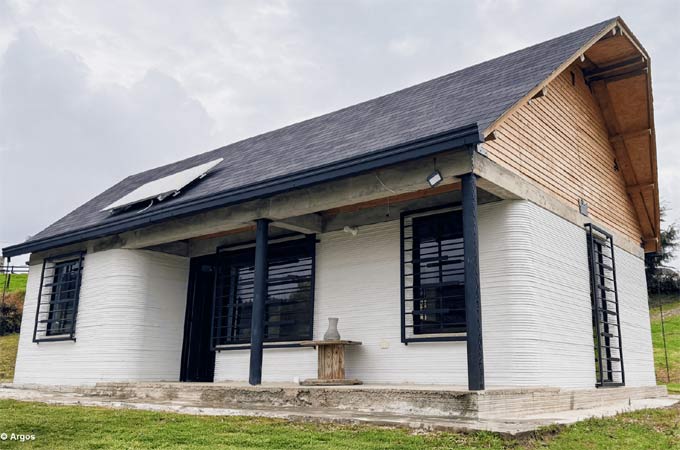
Two families in rural Colombia have received the keys to the first 3D printed social homes in South America.
With 3D printed walls by Cementos Argos using a COBOD BOD2 3D Construction Printer, the two houses in La Unión, Antioquia, were completed in just three days of printing, making them 30% faster to build and using 20% less material than conventional methods. The project proves how 3D construction printing can provide affordable, sustainable, and resilient housing, said a statement. Two single-story houses of 63 sq m each were printed on site in just 16 hours of wall printing.Key features included:* Printed with a specially developed Argos mortar mix with compressive strength above 35 MPa (5,076 psi)* Homes designed for local climatic and seismic conditions with earthquake-resistant structures* Project partners include Casa Para Mí (social initiative by Cementos Argos), Future Tech (Cementos Argos innovation unit), Comfama (Family compensation fund), the municipality of La Unión, and Fundación Berta Martínez (contractor).The two houses with two bedrooms, a living room, kitchen, bathroom, laundry area, and porch, were printed layer by layer using a COBOD BOD2 3D Construction Printer. The walls with a total height of 2.2 m were printed in just 16 hours over three days. By adopting 3D construction printing, Cementos Argos reduced construction time by 30%, material consumption by 20%, and waste generation by up to 30% compared to conventional methods.Cementos Argos also developed a custom mortar mix for the project. The material achieved a compressive strength above 35 MPa (5,076 psi) and a flexural strength of 8 MPa (1,160 psi), ensuring earthquake resistance. By incorporating calcined clay, the mix reduced environmental impact while aligning with the company’s sustainability goals. This approach was further supported by COBOD’s open-source material strategy, which enables the 3D printer to work with a wide variety of mixes.The printer was transported in five small trucks to navigate the mountainous terrain and was assembled on site in humid, tropical weather. Despite heavy rains, the team achieved uninterrupted printing, demonstrating the adaptability of both the printer and the material mix under challenging conditions.Cementos Argos is already evaluating new opportunities for rural housing using this technology. Large scale projects like this are essential to making 3D printed housing more affordable and are already being applied by other COBOD customers worldwide.Beyond technology, the project has immediate benefits for local families. With the keys now officially handed over, the initiative moves beyond proof of concept to real social impact. Families in La Unión are moving into homes designed to withstand local climatic and geographical conditions, helping close Colombia’s housing gap with durable and sustainable solutions.“Through this project, we reaffirm our leadership in innovation and adoption of new construction methods, contributing to the development of sustainable products and solutions for the industry. Helping to close Colombia’s housing gap and making housing dreams a reality” said Juan Esteban Calle, President of Cementos Argos.
Gulf Construction
Cementos Argos builds 3D printed social homes in South America