
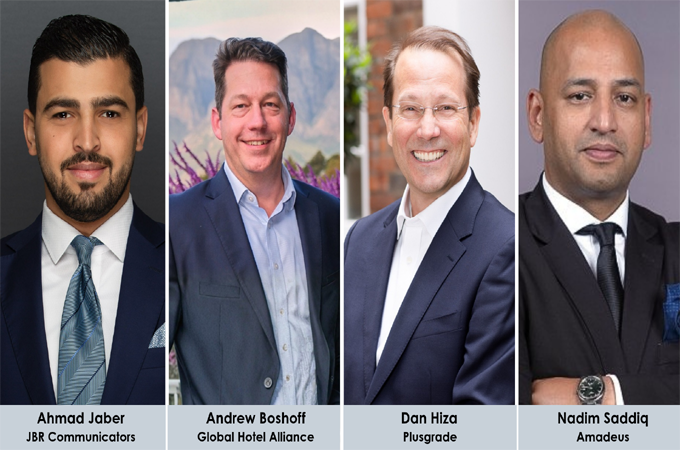
How guests use AI to choose hotels, how to grow revenue when demand is uncertain and how to get teams using new tools are among the pressing topics at the HSMAI Commercial Strategy Conference MEA 2026 (CSC MEA 2026), held under the theme “Resilience. Agility. Results. The spirit that defines MEA”.
In the lead-up to the event, Mona Faraj, President, HSMAI
Middle East & Africa, put three questions on technology, commercial
priorities and AI adoption to four industry leaders.
Their answers show broad agreement that AI delivers most
when hotels start with a clear business problem, build on sound data and keep
people in charge of the guest experience.
With inputs from Ahmad Jaber, Executive Director –
Marketing, Creative Studio & Business Development, Dubai Office, JBR
Communicators; Andrew Boshoff, CFO Global Hotel Alliance; Dan Hiza, VP of
Business Development, Hospitality Upsell, Plusgrade and Nadim Saddiq, Regional
Director Middle East & Africa - Amadeus Hospitality.
What is the biggest transformation you are anticipating in
hospitality technology in the next couple of years?
Ahmad Jaber: The biggest transformation will be how AI
changes the way travellers discover, research, and select hotels. As AI powered
travel assistants become part of the guest journey, hotels must rethink their
digital visibility and invest in Generative Engine Optimization (GEO).
Marketing teams will need greater agility to adapt their content, channels, and
distribution strategies. The challenge will be to embrace new technologies
quickly while maintaining consistent brand positioning across an increasingly
fragmented digital landscape.
Andrew Boshoff: It’s a cliché now but the answer is going to
be related to AI. We recently conducted a survey among our hotel brand CEOs and
one of the report’s most striking findings concerns the future of hotel
distribution. By 2030, 87% of surveyed CEOs expect AI assistants to be among
the most influential hotel-booking channels. Marketing and personalisation is
the area where CEOs most expect AI to have an impact (73%), followed by revenue
management (67%), distribution (60%) and internal productivity (60%). Overall,
90% believe AI will either fundamentally reshape hospitality or have a positive
impact on the industry. I think they are right.
Dan Hiza: I expect the biggest shift will be AI becoming
part of everyday commercial decisions across the guest journey. Hotels will be
better able to connect guest preferences, available inventory and pricing to
offer something relevant at the right moment, whether that’s a room upgrade or
a later checkout. The real transformation will be making that level of
personalisation practical at scale, with hotel teams retaining control over the
guest experience.
Nadim Saddiq: I believe the combination of AI and data will
fundamentally change how hotels use technology, moving from individual tools
toward more connected, intelligent experiences. The biggest opportunity will be
using both AI and data to simplify operations, support better decision-making
and deliver more relevant guest experiences, while keeping people at the heart
of hospitality.
What do you see as the most important commercial challenge
and/or opportunity for hotels in the Middle East and Africa over the next 12
months?
Andrew Boshoff: We are operating in an uncertain
geo-political environment but, as an industry, we have learned to stay agile
and adapt to changing circumstances. And, most importantly, the travel
community is proving more resilient than it would have been in previous decades,
so we remain optimistic. International travel demand is rising relentlessly,
particularly in the leisure segment, and the strength of our alliance – driven
by our loyalty platform, GHA DISCOVERY – positions our brands to capitalise on
this momentum. The Middle East continues to play a pivotal role in shaping the
future of tourism, and we remain optimistic about the opportunities that lie
ahead for our industry. The challenge in the next 12 months will be to build
customer confidence in the face of this uncertainty, using tools such as
booking flexibility, personalised promotions and a focus on targeting the right
feeder markets at the right times.
Dan Hiza: The biggest opportunity is to grow revenue from
the whole stay. Across a region as diverse as the Middle East and Africa,
demand conditions differ, but hotels can make better use of what they already
offer. Premium rooms, dining, experiences and flexible arrival or departure
times all have commercial potential. The challenge is making those offers
relevant to each guest and measuring their contribution to profit, alongside
occupancy and room rate.
Nadim Saddiq: In my view, the opportunity is balancing
strong growth ambitions with profitability. Hotels need to become smarter about
how they attract demand, optimize distribution and understand their guests. In
the Middle East and Africa, using data and technology effectively can be a
significant competitive advantage.
Ahmad Jaber: The biggest challenge will be how quickly hotel
commercial teams can adapt to changing market conditions. Resilience requires
creativity, flexibility, and the confidence to act when others become
defensive. Hotels should explore new source markets, anticipate emerging guest
profiles, and develop local business, weddings, and MICE opportunities.
Marketing leaders must also optimize available resources, leverage external
expertise, and remain active across relevant channels. Agility should translate
into measurable commercial results.
From your perspective, what can/should hotels do to drive
more AI adoption across their operations?
Dan Hiza: Start with a specific problem teams want solved,
such as time spent preparing offers or missed upgrade opportunities. Involve
the people who will use the technology, choose tools that work with existing
systems, and set clear rules for data use and human oversight. Then measure the
impact on revenue, workload and guest satisfaction. Adoption becomes easier
when people can see the benefit in their daily work and have the training to
use it confidently.
Nadim Saddiq: Hotels should start with practical business
problems rather than AI itself. Identify areas where AI can genuinely improve
productivity, decision-making or the guest experience, then demonstrate
measurable value. Strong data foundations, connected technology and working
with the right partners to help orchestrate the AI-enabled ecosystem will be
critical to scaling AI successfully and responsibly.
Ahmad Jaber: Hotels must invest in AI training and robust
data protection protocols to build more agile and efficient teams. Research
from Harvard Business School and BCG found that AI-assisted professionals
worked over 25% faster, achieved over 40% higher quality scores, and completed
12% more tasks. These findings demonstrate AI’s potential to improve
productivity and optimize resources. Human emotional intelligence remains
essential. Hoteliers must exercise judgment, evaluate AI-generated work, and
monitor outcomes, allowing talent to focus on creativity, strategic thinking,
and meaningful guest interactions.
Andrew Boshoff: Hotels should start with clear business
objectives rather than adopting AI for its own sake. Analyse how your team
members spend their time and use that to identify high-impact use cases where
AI can make a real difference today. Don’t underestimate the importance of
dealing with the “boring” cases, where AI can to take time-consuming tasks away
from staff who will see the quick wins and will be encouraged to bring AI tools
to bear on more complex tasks. Encourage teams to experiment with AI and to
share their results, both good and bad, so that everyone can be part of the
broader AI journey. Develop a culture that celebrates this experimentation and
where people are not afraid to fail responsibly. Remember that AI works best on
good data, so invest time and resources in making sure that there is a solid
foundation to all of your business data.
These questions will be debated at Conrad Dubai on 17 and 18 November, when CSC MEA 2026 brings together the region’s leading hospitality experts in sales, marketing, revenue management and distribution. This year’s programme features 18 hours of learning and insights across 40 sessions, nine engaging content formats, 65+ expert speakers, seven ROCKSTAR award finalists, and four hours of networking to turn conversations into connections. -TradeArabia News Service