
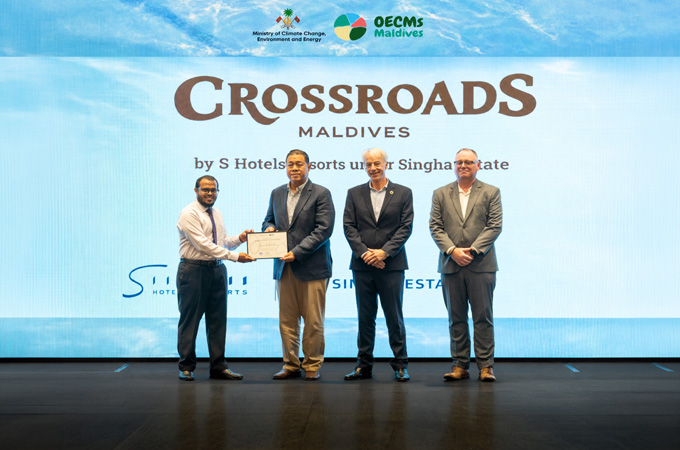
CROSSROADS Maldives has achieved a conservation milestone, with a 1.71-square-kilometre area within the integrated leisure destination officially recognised as an Other Effective Area-Based Conservation Measure (OECM) by the Maldives’ Ministry of Climate Change, Environment & Energy.
The recognition marks a significant step in the
destination’s efforts to protect marine biodiversity while advancing
sustainable tourism. The designated area spans part of Emboodhoo Lagoon in
South Malé Atoll and is the largest recognised OECM area in the Maldives.
The conserved zone forms an important ecological corridor
adjacent to three resorts within CROSSROADS Maldives: SAii Lagoon Maldives,
Curio Collection by Hilton, Hard Rock Hotel Maldives and SO/ Maldives.
OECMs are areas that contribute to the long-term
conservation of biodiversity outside traditional protected areas. The
CROSSROADS OECM is managed in collaboration with local communities, private
sector organisations and government agencies.
Since the destination’s launch in 2019, conservation efforts
have focused on balancing biodiversity protection, controlled recreation,
sustainable resource use and environmental impact mitigation. Drone
surveillance, underwater cameras and GPS monitoring are used to support
compliance and transparency across the conserved area.
The site supports a diverse marine ecosystem, with more than
37 coral genera and 177 reef fish species recorded. It also provides nursery
and feeding grounds for 24 species listed on the International Union for
Conservation of Nature (IUCN) Red List.
Among the species recorded in the area are the hawksbill
turtle, ornate eagle ray, bowmouth guitarfish, giant guitarfish and scalloped
hammerhead, alongside other shark species and sea turtles. The OECM also
protects a key migration route for spinner and bottlenose dolphins, with
sighting probabilities reaching 86%.
The recognition is expected to deliver long-term benefits
for local communities, nearby islands, government partners, researchers, guests
and investors.
In addition to strengthening marine conservation and
supporting sustainable resource use, the designation will help safeguard
important dive sites, including Emboodhoo Canyon. It will also create
opportunities for Maldivian students and researchers to participate in marine
conservation initiatives, supporting the long-term protection of the country’s
marine ecosystems.
The milestone reinforces CROSSROADS Maldives’ approach to
integrating environmental conservation with tourism development, highlighting
the role of private-sector initiatives in protecting the Maldives’ natural
heritage.
Chairath Sivapornpan, CEO of Singha Estate, said: “The
recognition of CROSSROADS Maldives as an OECM demonstrates that integrating
nature into business decisions from the outset can deliver measurable results.
In biodiversity-rich destinations, development should begin with understanding
and preserving nature’s intrinsic value for the long term.
At Singha Estate, we work closely with experts, government
agencies, partners, and local communities to align business growth, tourism,
and conservation. We see biodiversity as a vital asset and foundation for
long-term business value. This OECM recognition reflects our ongoing commitment
and marks another step towards the global 30x30 target, reinforcing our
ambition to create lasting value for business, nature, society, and local
communities across every destination in which we operate.”
At CROSSROADS Maldives, this commitment is strongly
reflected in the day-to-day management of the destination, supported by
continuous monitoring, research and collaboration with local and national
partners.
“For us at S Hotels & Resorts, conservation is not something that sits alongside our operations, it is part of how we operate,” said Mr. Michael Marshall, CEO of S Hotels & Resorts. “The recognition of CROSSROADS Maldives as an OECM is a significant milestone in SHR’s sustainable development strategy and our commitment to protecting 30% of key biodiversity areas. It demonstrates that our long-term efforts to understand, protect and restore the marine ecosystem around us are delivering meaningful results. From monitoring biodiversity and safeguarding critical habitats to engaging our guests and local communities, every action contributes to this commitment. This recognition is both a testament to what we have achieved and a motivation to go further, strengthening our conservation efforts and creating lasting value for people, nature and the destinations where we operate.” -TTN